
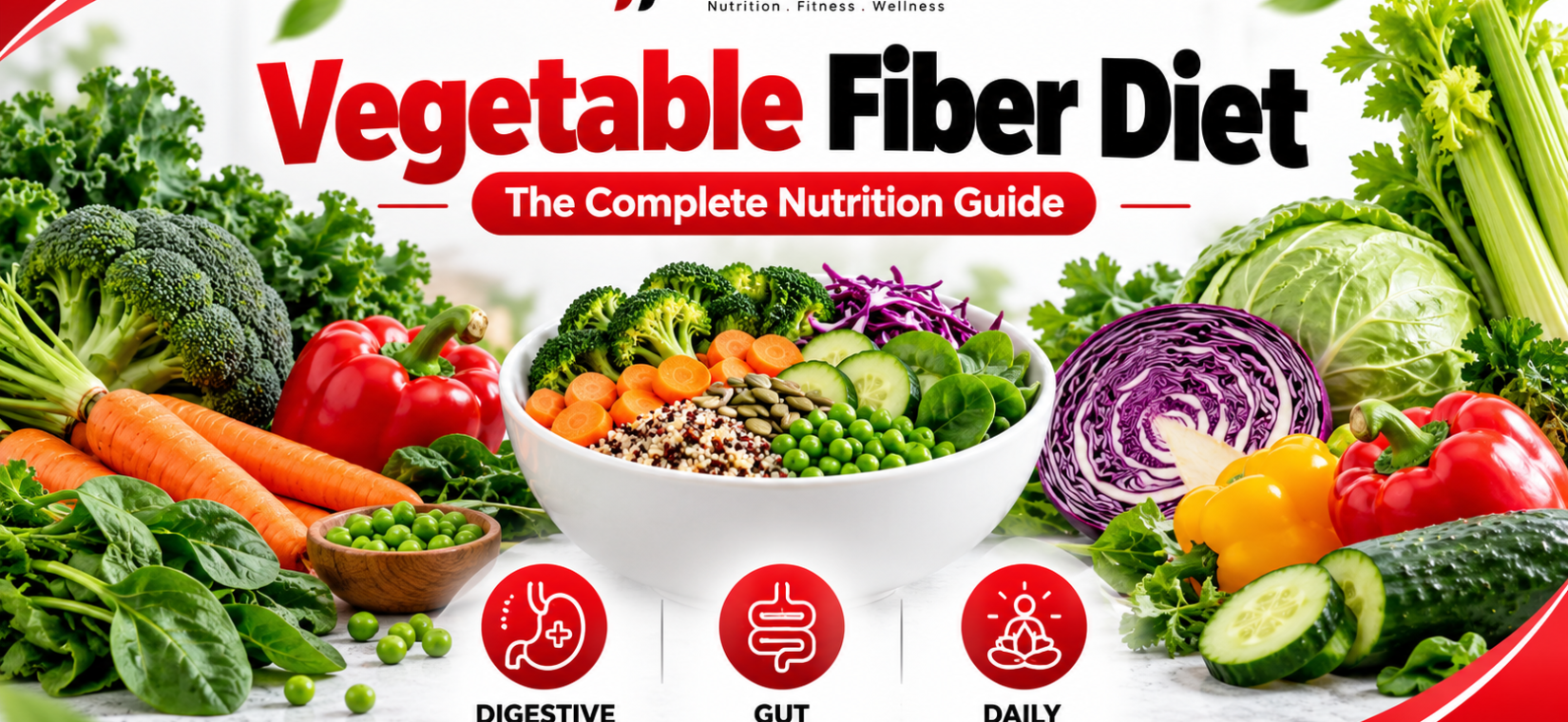
A vegetable fiber diet is an eating pattern that centers daily meals on fiber-rich vegetables to reach recommended fiber intakes of 25–38 grams per day for adults. A well-planned vegetable fiber diet supports digestion, feeds beneficial gut bacteria, steadies blood sugar, and helps with satiety and weight management — all from ordinary vegetables prepared in simple ways.
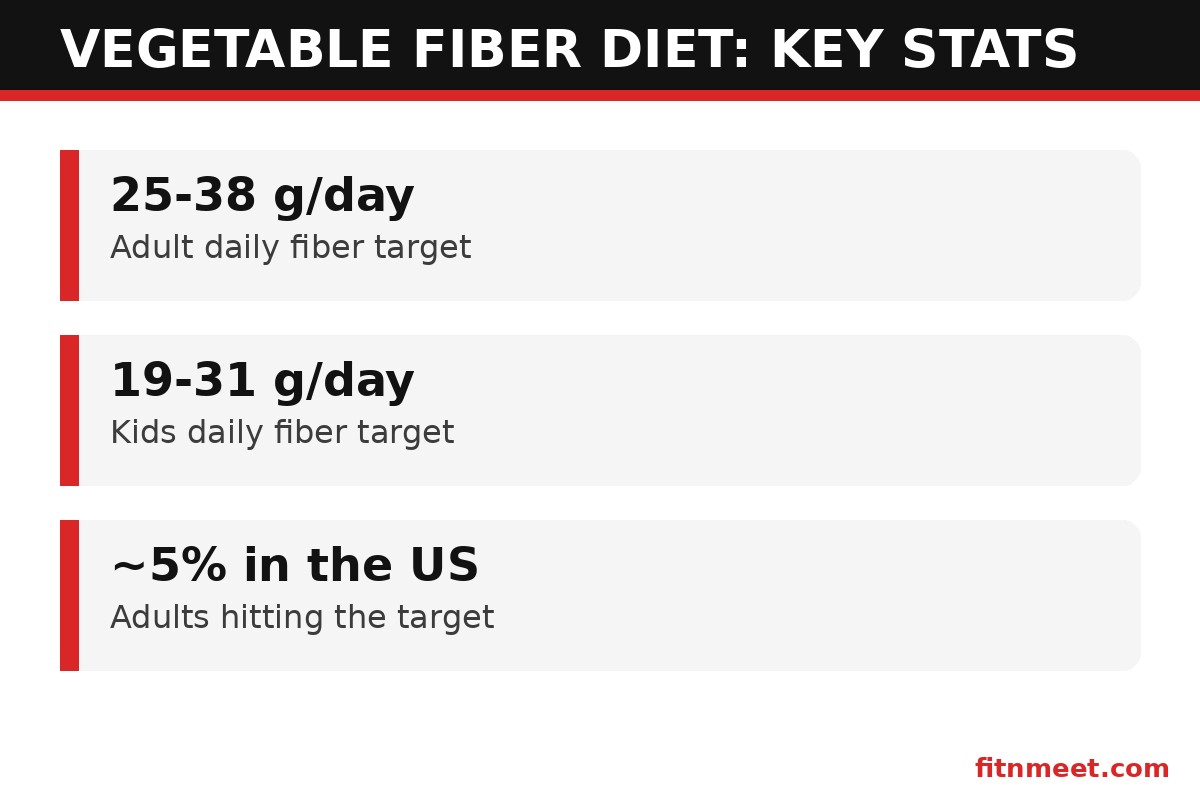
15 g — average daily fiber intake of US adults · 28 g — FDA Daily Value for fiber · ~5% — share of Americans meeting fiber recommendations
Vegetable Fiber Diet: Key Stats Snapshot
Before the details, here is the numerical case for a vegetable fiber diet — because fiber is one of the few nutrition topics where the numbers tell the whole story.
15 g
Average daily fiber intake. Analyses of US national dietary survey data consistently put average adult fiber intake at roughly 15–16 grams per day — barely half the FDA’s 28-gram Daily Value and well under the Institute of Medicine’s adequate intakes of 38 grams for men and 25 grams for women. A vegetable fiber diet exists precisely to close this gap.
~5%
Share of Americans meeting recommendations. Published analyses of NHANES data have estimated that only about 5% of Americans consume the recommended amount of fiber. Fiber is arguably the most under-consumed nutrient in the modern diet — a “nutrient of public health concern” in US dietary guidance.
5.1 g
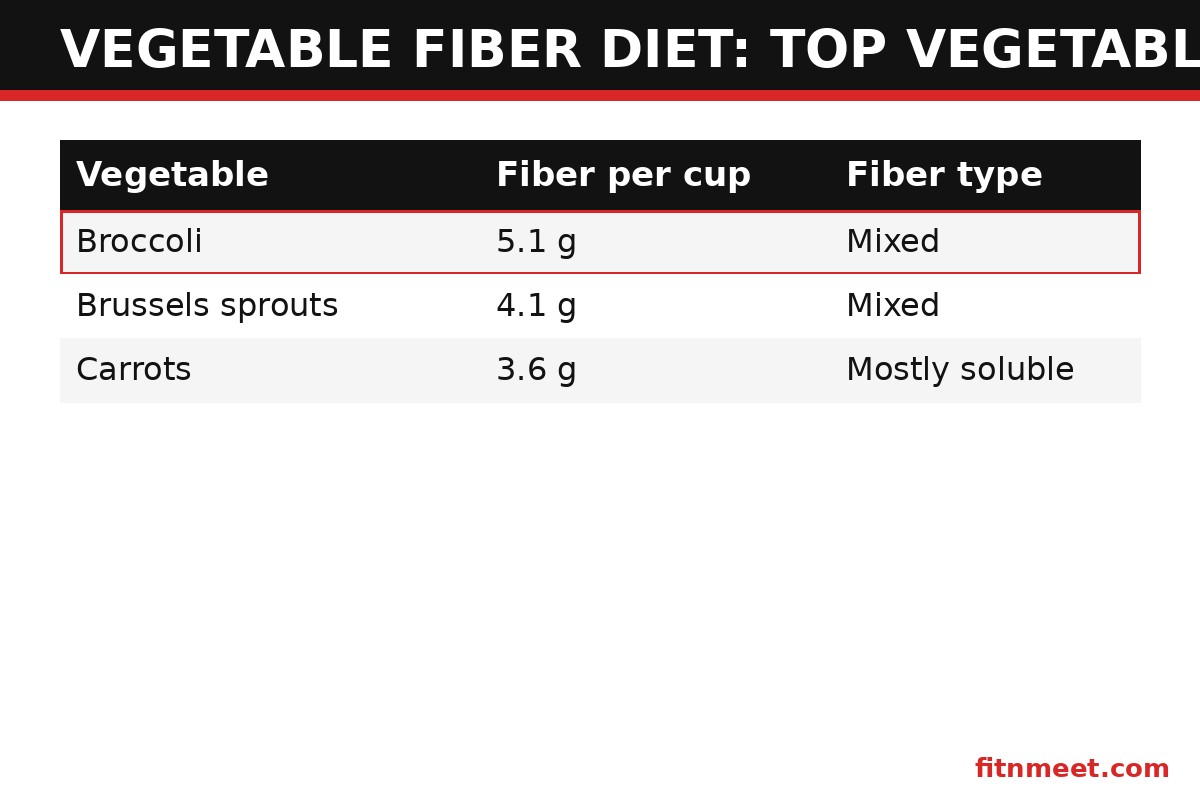
Fiber in one cup of cooked broccoli. Vegetables are among the most fiber-dense foods per calorie you can eat. One cup of cooked Brussels sprouts delivers about 4.1 grams, a cup of cooked carrots about 3.6 grams, and a cup of green peas nearly 9 grams. Three to four vegetable servings a day can supply half or more of a 25–30 gram target.
2 types
Soluble and insoluble fiber — vegetables supply both. Soluble fiber (oats, carrots, Brussels sprouts) forms a gel that slows digestion and helps manage cholesterol and blood sugar. Insoluble fiber (leafy greens, cauliflower, celery) adds bulk and speeds transit. A vegetable fiber diet built on variety covers both automatically. The chemistry is summarized well on Wikipedia’s dietary fiber page.
What Is a Vegetable Fiber Diet?
A vegetable fiber diet is not a branded program with phases and packaged products. It is a simple framework: make vegetables the fiber backbone of every meal, aiming for 4–5 servings a day, and let that habit carry you to (or near) recommended fiber intakes. Unlike fiber-supplement regimens built on powders, this approach delivers fiber packaged with water, vitamins, minerals, and phytonutrients — the whole-food matrix that isolated fiber cannot replicate.
What counts? Practically any non-starchy vegetable contributes: broccoli, cauliflower, Brussels sprouts, carrots, spinach, kale, peas, artichokes, sweet potatoes, beets, and peppers are among the highest-fiber choices. Starchy vegetables like potatoes and corn add fiber too, though with more digestible carbohydrate alongside. The diet is flexible about preparation — raw, steamed, roasted, stir-fried, or blended into soups and smoothies all count, with a slight edge to cooking methods that keep the vegetable intact rather than juicing, which strips most fiber away.
This way of eating is compatible with nearly every eating style: omnivore, vegetarian, vegan, Mediterranean, and most weight-management plans. It is not inherently low-carb (sweet potatoes and peas contain meaningful carbohydrate) and not inherently low-calorie, though in practice high-fiber vegetable meals are satiating at modest calorie counts — one reason fiber-rich eating patterns are consistently associated with healthier body weights in observational research.
Benefits of a Vegetable Fiber Diet
The benefits flow from what fiber does in the gut and beyond. Here are the best-supported ones:
- Digestive regularity. Insoluble fiber adds stool bulk and speeds transit time; adequate fiber intake is first-line guidance for preventing constipation. The National Institute of Diabetes and Digestive and Kidney Diseases lists fiber-rich eating among its core recommendations for digestive health.
- Gut microbiome support. Soluble fibers and resistant starches are fermented by colonic bacteria into short-chain fatty acids such as butyrate, which nourish colon cells and are linked to a healthier gut lining. Vegetable diversity matters here: different fibers feed different bacterial species.
- Steadier blood sugar. Fiber slows carbohydrate absorption, blunting post-meal glucose spikes. Meals built around vegetables produce a gentler glycemic response than refined-carbohydrate meals of equal calories.
- Cholesterol management. Soluble fiber binds bile acids in the gut, prompting the liver to pull cholesterol from the blood to make more — a mechanism behind fiber’s modest LDL-lowering effect, typically a few percentage points at meaningful intakes.
- Satiety and weight control. High-fiber vegetable meals stretch the stomach, slow eating, and trigger fullness hormones. People who eat more vegetables at meals consistently report greater satiety per calorie.
- Nutrient density. The same vegetables supplying fiber also deliver potassium, magnesium, folate, vitamin C, vitamin K, and carotenoids — nutrients of concern in typical Western diets.
31 g
Typical fiber shortfall this diet closes. Moving from ~15 grams to ~30 grams daily is the realistic win of this plan — a doubling achieved with roughly two extra vegetable servings plus smarter choices at meals you already eat.
Building your plan? Pair your new eating pattern with the fundamentals: explore FitnMeet’s nutrition guides and health support collection for complementary reading on balanced eating.
For a convenient vitamin C option, see our vitamin C gummies benefits and dosage.
How a Vegetable Fiber Diet Works
Understanding the mechanism helps you make better food choices. When you eat this way, two parallel processes begin. First, in the small intestine, soluble fiber dissolves into a viscous gel. This gel slows the emptying of the stomach and the absorption of sugars and fats — the reason a lentil-and-vegetable soup keeps you full for hours while white bread does not. Viscosity is the key property: the thicker the gel a fiber forms, the stronger the effect on satiety and glucose.
Second, in the large intestine, fermentable fibers become food for your gut bacteria. This pattern delivers a wide range of fermentable substrates — pectins from carrots, inulin-type fructans from onions and garlic, resistant starch from cooled cooked potatoes — and microbial diversity tracks dietary fiber diversity in study after study. The fermentation products, short-chain fatty acids, provide roughly 5–10% of daily energy needs and play signaling roles in inflammation and metabolism that researchers are still mapping.
Insoluble fiber, meanwhile, largely survives fermentation and does mechanical work: holding water, adding bulk, and stimulating peristalsis. Leafy greens, cauliflower, and celery are rich sources. A plan that includes both raw crunchy vegetables (insoluble-heavy) and cooked soft ones (more soluble available) gets the full mechanical-plus-metabolic package.
One underappreciated mechanism: chewing. High-fiber vegetables require more chewing, which slows eating rate and gives satiety signals time to register — studies on eating rate show meaningful differences in intake when the same calories are delivered in chewy versus soft form. It works partly because it forces you to slow down.
Vegetable Fiber Diet: How Much Fiber You Need
Targets first, then the checklist to hit them. Official guidance:
- Adult men: 38 grams per day (Institute of Medicine adequate intake); FDA Daily Value: 28 grams
- Adult women: 25 grams per day; FDA Daily Value: 28 grams
- Children: roughly age plus 5 grams (a 10-year-old: ~15 grams), rising toward adult levels in the teens
- Practical vegetable fiber diet target: 25–30 grams daily from food, with vegetables supplying at least half
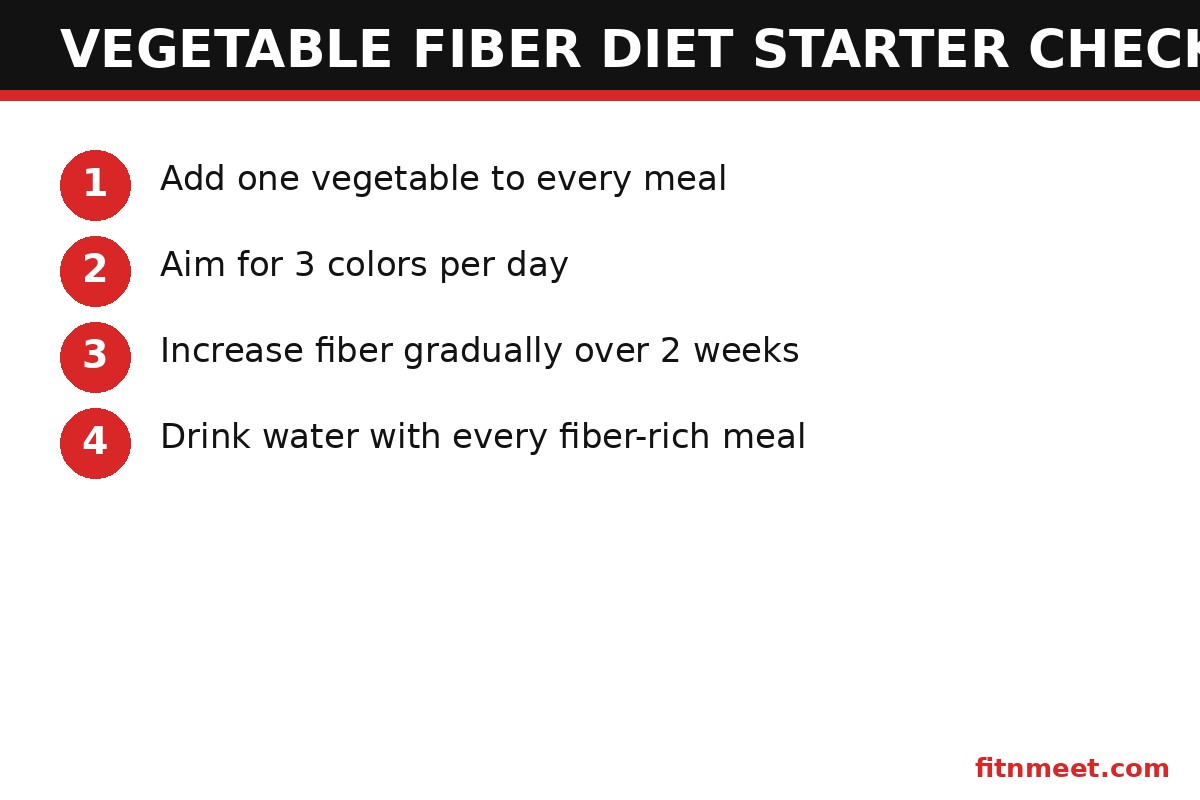
Use this checklist to build the habit over two weeks:
- ☐ Days 1–3: Add one vegetable serving to your current biggest meal (e.g., a side salad or steamed broccoli at dinner).
- ☐ Days 4–7: Add vegetables to a second meal — spinach in eggs, peppers in a wrap, carrot sticks as a snack.
- ☐ Days 8–10: Make vegetables half your dinner plate; aim for two different colors.
- ☐ Days 11–14: Add a vegetable to breakfast (greens in a smoothie, tomatoes on toast) and track a full day’s fiber with the FDA Nutrition Facts label guide % Daily Value column.
- ☐ Ongoing: Drink water with every fiber-rich meal — fiber needs fluid to do its work.
A sample 30-gram day: oatmeal with berries at breakfast (8 g), a large mixed salad with chickpeas at lunch (10 g), an apple as a snack (4 g), and stir-fried broccoli, peppers, and brown rice at dinner (8 g). Notice vegetables appear at every meal — that is the whole method.
Vegetable Fiber Diet vs Other High-Fiber Diets
How does it stack up against other popular high-fiber approaches?
| Approach | Fiber source | Typical daily fiber | Strengths | Trade-offs |
|---|---|---|---|---|
| Vegetable fiber diet | Vegetables at every meal | 25–35 g | Nutrient-dense, low-calorie, sustainable | Requires cooking habit |
| Whole-grain heavy | Oats, brown rice, whole wheat | 25–30 g | Easy swaps (bread, cereal) | More calories per gram of fiber |
| Legume-centered | Beans, lentils, chickpeas | 30–40 g | Highest fiber per serving; cheap | Gas/bloating during adaptation |
| Fiber-supplement based | Psyllium, powders | 20–30 g | Precise dosing, convenient | No vitamins, phytonutrients, or chewing benefit |
| Typical Western diet | Refined grains, few vegetables | ~15 g | — | Chronic shortfall |
The verdict: the vegetable-centered approach is the most nutrient-dense route to adequate fiber, but it combines well with the others. The highest-fiber eaters in population studies typically mix vegetables, legumes, and whole grains — there is no prize for fiber monogamy. If your goal includes weight management, FitnMeet’s weight loss collection and the main shop offer complementary resources.
For plant-based nutrient coverage, see our vegetarian multivitamin supplements guide.
Vegetable Fiber Diet: Side Effects & Adjustment
Increasing fiber quickly is the classic mistake: gas, bloating, and cramping when gut bacteria suddenly receive far more fermentable substrate than usual. The fix is gradualism — add roughly 5 grams per week, not 15 overnight — plus water. Fiber absorbs water; without enough fluid, extra fiber can paradoxically worsen constipation rather than relieve it. Aim for an extra glass or two of water daily as you ramp up.
Most adaptation discomfort fades within 1–2 weeks as the microbiome adjusts. Persistent issues usually trace to one of three causes: increasing too fast, inadequate hydration, or a sudden large dose of a single high-fermentability food (a full cup of beans on day one is the canonical error). Spread fiber across meals rather than loading it into one.
Who should be cautious? People with IBS may react to specific fibers (onion, garlic, and large amounts of cruciferous vegetables are common triggers) and often do better personalizing within it rather than abandoning fiber. Those with swallowing difficulties or certain GI strictures should follow medical guidance. For everyone else, the adjustment period is the only real “side effect” of a vegetable fiber diet — and it is entirely manageable with the two-week ramp in the checklist above.
Alternatives to a Vegetable Fiber Diet
If a vegetable-centered approach does not fit your life, several alternatives reach the same fiber targets. A legume-centered diet (beans, lentils, chickpeas daily) delivers the most fiber per bite — a cup of cooked lentils packs about 15.6 grams, more than most people get all day. A whole-grain strategy swaps refined breads, rice, and cereals for intact versions, adding 3–5 grams per swap with zero extra cooking. Fruit-heavy approaches work too: raspberries (8 g per cup), pears (5.5 g each), and apples (4.5 g each) are fiber standouts.
Fiber supplements like psyllium husk have legitimate uses — travel, illness, or bridging a genuinely vegetable-free week — and clinical trials support psyllium for cholesterol and regularity. But supplements deliver fiber without the vitamins, minerals, phytonutrients, water content, and chewing-mediated satiety of whole vegetables. Think of them as insurance, not the plan.
The pragmatic answer for most people: keep vegetables as the base and layer in legumes and whole grains where convenient. Fiber sources are complementary, and dietary patterns associated with the best long-term outcomes in cohort studies are diverse, not dogmatic.
If you prefer a food-first approach, see getting vitamins from food sources.
Vegetable Fiber Diet: FAQs
What is a vegetable fiber diet?
A vegetable fiber diet is an eating pattern that makes fiber-rich vegetables the center of daily meals, aiming for 4-5 vegetable servings a day to reach 25-38 grams of fiber. It emphasizes broccoli, leafy greens, carrots, peppers, peas, and similar vegetables prepared simply, and works within omnivore, vegetarian, and vegan eating styles.
How much fiber do I need on a vegetable fiber diet?
Adults should target 25 grams (women) to 38 grams (men) per day, with the FDA Daily Value set at 28 grams. A practical vegetable fiber diet goal is 25-30 grams from food with vegetables supplying at least half. Increase gradually, about 5 grams per week, to avoid bloating.
Which vegetables have the most fiber?
Top choices for a vegetable fiber diet include artichokes (about 7 g each), green peas (about 9 g per cup), broccoli (5.1 g per cooked cup), Brussels sprouts (4.1 g per cooked cup), sweet potatoes (about 4 g each), and carrots (3.6 g per cooked cup). Eating a variety covers both soluble and insoluble fiber.
Can a vegetable fiber diet help with weight loss?
It can support weight management: high-fiber vegetable meals increase satiety per calorie, slow eating rate, and blunt blood sugar spikes, all of which make calorie control easier. Observational studies consistently link higher vegetable and fiber intakes with healthier body weights, though total calories still determine weight change.
Does cooking destroy fiber in a vegetable fiber diet?
No. Cooking softens vegetables but does not meaningfully reduce fiber content; some cooked vegetables even show slightly higher measurable fiber. What does remove fiber is juicing, which strips away nearly all of it. For a vegetable fiber diet, eat vegetables whole – raw, steamed, roasted, or blended into soups and smoothies.
What are the side effects of starting a vegetable fiber diet?
The main adjustment effects are gas and bloating if fiber increases too fast. Add about 5 grams per week, drink extra water with fiber-rich meals, and spread fiber across the day. Most discomfort fades within 1-2 weeks as gut bacteria adapt to the higher intake.
This article is for informational purposes only and is not medical advice. Consult a healthcare professional before starting any supplement or exercise program.
Conclusion
A vegetable fiber diet is one of the simplest high-leverage changes in nutrition: no exotic foods, no expensive products, just more vegetables, more often, until 25–30 grams of fiber becomes your normal. The payoff — better digestion, a healthier gut microbiome, steadier energy, and easier weight control — is backed by some of the most consistent evidence in dietary science. Start with the two-week checklist, keep water intake up, and let the vegetables do the work.
For more practical nutrition guidance, explore FitnMeet’s nutrition articles and blog.