
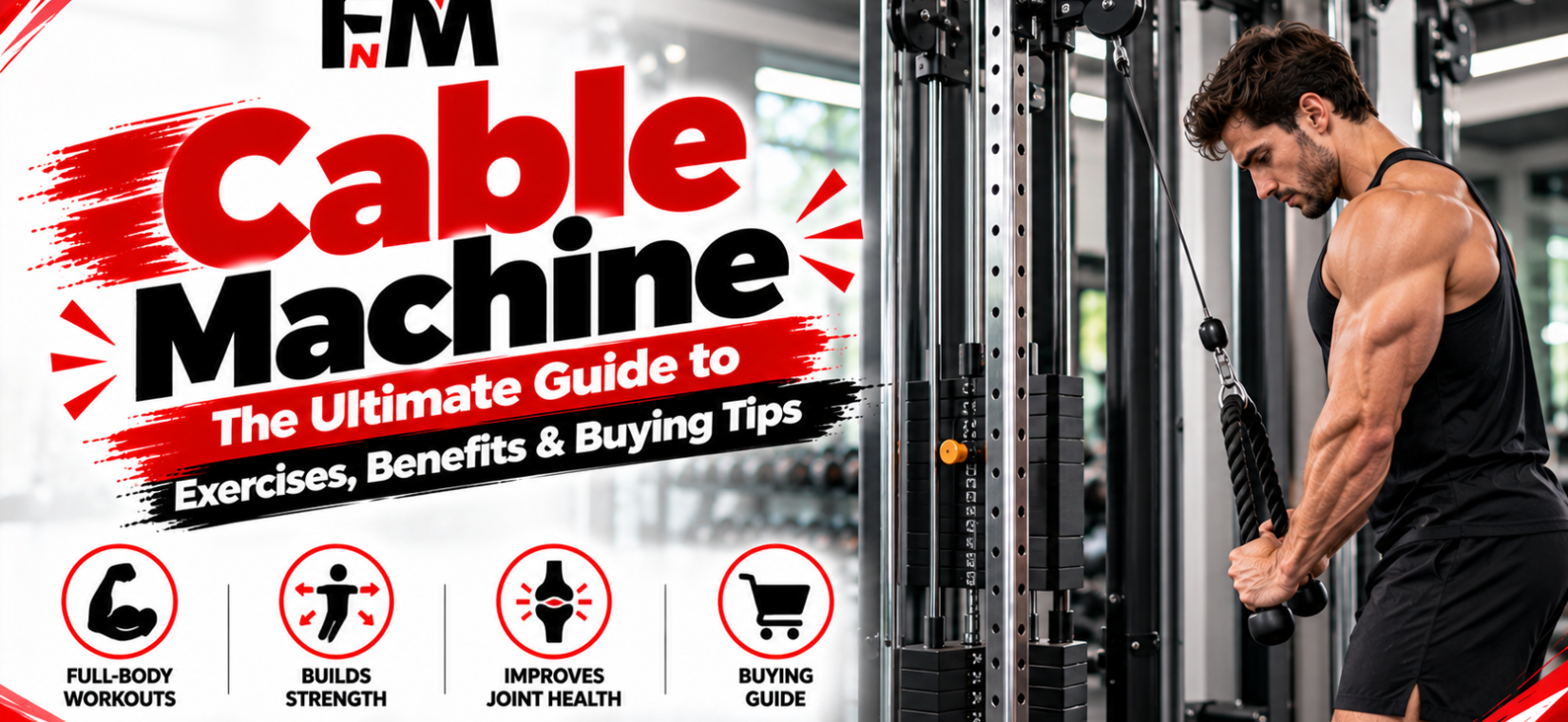
A cable machine is one of the most versatile tools in any gym. Using adjustable pulleys and a weight stack, it delivers constant tension through every inch of each rep, something free weights cannot replicate. Whether you want to build muscle, improve definition, or train around injuries, a cable machine deserves a central place in your program.
This guide covers everything: how cable machines work, the main types, the 8 best exercises with form tips, 5 proven benefits, how cables compare to free weights and bands, which attachments to use, how to keep progressing, buying advice with real pricing, maintenance, sample workouts, mistakes to avoid, and answers to common questions.
What Is a Cable Machine?
A cable machine is a strength training station built around one or more adjustable pulleys connected to a weight stack. You attach handles, bars, or straps to the cables and perform pushing, pulling, and rotational movements. Because the cable redirects force, your muscles work against resistance through the entire range of motion, unlike dumbbells where tension drops at the top of a curl or press.
Common configurations include single-column towers, dual-pulley functional trainers, lat pulldown stations, and full cable crossover stations.
Types of Cable Machines
Functional trainer: Dual adjustable pulleys on a compact frame. The most versatile cable machine for home gyms, handling everything from chest flyes to rows to rotational core work.
Lat pulldown / low row: A dedicated station for back training, with a high pulley for pulldowns and a low pulley for rows.
Cable crossover: Two weight stacks with high and low pulleys on a wide frame, the classic commercial-gym station for chest, shoulders, and arms.
Rack-mounted pulley: A hi/low cable attachment that bolts onto a power rack, bringing cable versatility to a compact footprint.
8 Best Cable Machine Exercises
1. Cable chest fly: Set the pulleys at shoulder height and bring the handles together in a hugging motion for a deep pec contraction. Keep a slight bend in the elbows and squeeze for a full second at the midpoint.
2. Lat pulldown: The foundational back builder. Pull the bar to your upper chest with a controlled tempo, driving your elbows down and back. Avoid leaning excessively — a slight lean is fine, a row is not a pulldown.
3. Cable row: Sit tall and row the handle to your torso, squeezing your shoulder blades together. Keep your chest up and avoid rocking for momentum.
4. Cable lateral raise: Set the pulley low and raise the handle out to the side for capped delts with constant tension. The cable keeps working your delts at the bottom where dumbbells go slack.
5. Triceps pushdown: Pin your elbows at your sides and press the bar down until your arms are straight. Only the forearms move — if your shoulders swing, drop the weight.
6. Cable biceps curl: Face the pulley and curl with continuous tension from stretch to contraction. Step back slightly so the cable pulls at an angle for a stronger peak contraction.
7. Cable woodchopper: Set the pulley high and rotate your torso diagonally for powerful obliques. Pivot on the back foot and keep the arms relatively straight — the rotation comes from the core.
8. Face pull: Pull the rope toward your forehead with external rotation, the ultimate shoulder-health exercise. This is the one movement every lifter should do twice a week for posture and rotator cuff balance.
5 Benefits of Training with a Cable Machine
1. Constant tension: Cables load the muscle through the full range of motion, maximizing time under tension for hypertrophy.
2. Joint-friendly resistance: The smooth, guided pull is easier on joints than heavy free weights, making cables ideal for high-volume work and training around nagging injuries.
3. Unlimited variety: Adjustable pulley heights and interchangeable handles enable hundreds of movements from a single station.
4. Safe solo training: No spotter needed. You can train to failure without risk, which matters for home gym lifters.
5. Perfect for intensity techniques: Fast pin adjustments make drop sets, supersets, and mechanical advantage strips seamless.
Cable Machine vs. Free Weights
Free weights build stabilizer strength and athleticism, while cables maximize tension and isolation. The smartest programs use both. Research directly comparing cable curl training with barbell curl training found similar muscle and strength gains, confirming the cable machine as a legitimate primary training tool rather than just an accessory (PubMed, 2020).
Practically: use free weights for heavy compounds (squat, deadlift, press) and cables for isolation, finishing work, and any movement where you want tension through the full range. They complement rather than compete.
Cable Machine vs Resistance Bands
Bands are cheap and portable, but their resistance curve is the opposite of ideal — easiest where you are strongest (the stretched position) and hardest at lockout. Cables provide even resistance throughout, and weight stacks allow precise progressive overload in small increments. Bands win for travel and warm-ups; cables win for serious hypertrophy training.
Cable Attachments Guide: Which Handle for Which Exercise
The right attachment changes the exercise. Stock these essentials:
Straight/lat bar: Pulldowns, rows, and pushdowns. The workhorse attachment — if you buy one, make it this.
V-handle (close grip): Close-grip rows and pushdowns. Easier on the wrists and allows heavier loading.
Rope: Face pulls, overhead triceps extensions, and hammer curls. The rope’s split ends allow a greater range of motion than a bar.
D-handles (single): Unilateral work — single-arm rows, curls, and lateral raises. Essential for fixing imbalances.
Ankle straps: Cable kickbacks and hip abductions for glute isolation.
EZ-curl bar attachment: A joint-friendly option for curls and pushdowns when straight bars bother your wrists.
Start with a straight bar, rope, and one D-handle. That trio covers 90 percent of cable training.
How to Choose the Right Cable Machine
For home gyms, a compact functional trainer or rack-mounted pulley offers the most versatility per square foot. Look for smooth pulley action, a heavy-enough weight stack (150 to 200 lb minimum for serious training), and sturdy steel construction.
The FT Hi/Low Pulley for power cages adds full cable functionality to your existing rack, a space-efficient way to get cable training at home. For dedicated back work, the ST Lat Pulldown with 300 lb stack delivers commercial-grade pulldowns and rows.
Check the weight stack size, cable quality (aircraft-grade steel cables last longest), pulley smoothness, and warranty before buying. Test the pulley glide if possible — gritty pulleys ruin the experience.
Cable Machine Price Guide
- Rack attachments ($150–$400): Hi/low pulley add-ons for existing power racks. The cheapest entry into cable training if you already own a rack.
- Compact functional trainers ($800–$2,000): The home-gym sweet spot. Dual pulleys, 150–200 lb stacks, small footprint. This is where most buyers should land.
- Full crossover stations ($2,000–$5,000): Commercial-grade dual stacks on a wide frame. For dedicated gym rooms and light commercial use.
- Commercial ($5,000+): Built for all-day gym traffic. Overkill for home use.
Do not forget attachments in the budget — a basic handle set adds $50 to $150.
Who Should Buy a Cable Machine?
Home gym lifters who want maximum exercise variety per square foot — nothing beats a functional trainer for versatility in 16 square feet. Physique-focused trainers who prioritize constant tension and isolation for hypertrophy. Lifters training around injuries who need joint-friendly resistance with precise load control. Beginners who benefit from guided movement paths and simple pin-selected weights.
You probably do not need one if you are a pure strength athlete focused on the big three lifts with limited space and budget — a bar, rack, and bench cover that ground. Everyone else will use a cable station weekly.
Cable Machine Maintenance
Cables are low-maintenance but not no-maintenance:
- Inspect cables monthly for fraying, kinks, or broken strands — especially near the pulleys. Replace at the first sign of damage; a snapping cable under load is dangerous.
- Wipe down guide rods and apply silicone lubricant every few months for smooth stack movement.
- Check pulley bolts for tightness quarterly. Loose pulleys wear cables unevenly.
- Keep the stack clean. Dust and chalk buildup between plates causes sticking. A quick wipe-down monthly prevents it.
- Do not slam the stack. Controlled negatives protect the cables, pulleys, and your neighbors’ sanity.
3 Cable Workouts for Different Goals
Workout 1 — Full-body hypertrophy (45 min): Cable chest press (3×10), lat pulldown (3×10), cable row (3×12), cable lateral raise (3×15), triceps pushdown (3×12), cable curl (3×12), face pull (2×15). Rest 60–90 seconds. Pair with enough protein — see our muscle-building nutrition guide.
Workout 2 — Push day: Cable chest fly (4×12), cable shoulder press (3×10), cable lateral raise (3×15), triceps pushdown (4×12), overhead rope extension (3×12). Add an adjustable bench for seated variations.
Workout 3 — Pull day: Lat pulldown (4×10), cable row (4×10), straight-arm pulldown (3×12), face pull (3×15), cable curl (3×12), hammer rope curl (3×12).
6 Mistakes to Avoid
1. Using too much weight: The number one cable sin. Momentum turns every cable exercise into a full-body heave. If the stack slams, reduce the weight.
2. Ignoring pulley height: Pulley position changes the resistance angle entirely. A chest fly with pulleys at the floor is a different exercise than at shoulder height — set it deliberately.
3. Rushing the eccentric: Letting the stack crash down wastes half the rep. Control the negative for 2–3 seconds.
4. Standing too close: Crowding the machine shortens the range of motion. Step back until the cable pulls at the intended angle with full stretch.
5. Never changing attachments: Using the same bar for everything leaves gains on the table. Match the handle to the movement.
6. Skipping unilateral work: Bilateral-only cable training hides imbalances. Single-arm and single-leg cable work builds balanced strength.
How to Keep Progressing on a Cable Machine
Progressive overload works the same on cables as anywhere else, and the pin-selected stack makes it uniquely convenient. Here is how to keep progressing month after month:
Add weight in small jumps: Most stacks move in 10–15 lb increments, which is too big a jump for isolation work. Magnetic add-on weights (1.25–5 lb) stick to the stack for micro-loading. This single accessory extends the useful life of any cable station by years.
Add reps before weight: When you cannot make the next pin jump, add reps instead. Work a weight from 3×10 up to 3×15 before moving the pin — you have earned the jump when the top of the range feels easy.
Slow the tempo: A 3-second eccentric with the same weight is a meaningfully harder set. Tempo is free progressive overload that requires no new equipment.
Track your setup: Log the pin position, attachment, and pulley height for each exercise. Cables have more variables than barbells — without notes, you waste sets rediscovering last week’s setup.
Rotate exercises every 4–6 weeks: Swap flyes for presses, wide pulldowns for close-grip, rope pushdowns for bar pushdowns. Novel stimuli keep growth coming when the weights stall.
Cable Machine FAQs
Can you build muscle with just a cable machine? Absolutely. With sufficient resistance and progressive overload, cables build serious muscle. Research confirms hypertrophy comparable to free weights.
How much space does a cable machine need? Compact functional trainers fit in a 4×4-foot area, while full crossover stations need 8×4 feet or more. Rack attachments need no extra floor space at all.
Are cable machines good for beginners? Yes. The guided path and simple weight selection make them ideal for learning movement patterns safely.
How much weight stack do I need? 150–200 lb per stack suits most home lifters. Stronger lifters doing heavy rows and pulldowns should look for 200+ lb. Remember: cable ratios vary — some machines list the stack weight, others the actual resistance.
Can cables replace a full gym? For hypertrophy and general fitness, a good functional trainer plus a bench covers nearly everything. Pure strength athletes will still want a barbell for maximal loading.
How often should I replace cables? With home use and regular inspection, quality aircraft-grade cables last 5–10 years. Commercial gyms replace them every 1–3 years depending on traffic.
Are cable crossovers worth it for home gyms? Only if you have the space and budget. Most home lifters get 90% of the benefit from a compact functional trainer or rack attachment at a fraction of the cost and footprint.
What is the best cable exercise for chest? The cable chest fly and cable press are the top two — the fly for stretch and contraction, the press for heavier loading. Rotate both.
Why does the stack sway during exercises? Swaying usually means the guide rods need cleaning and lubrication, or the cables have stretched unevenly. Clean and lubricate the rods first; if sway persists, have the cables inspected. Explosive reps also cause sway — control the tempo.