
Proteins and supplements are the two most confusing topics for new lifters. The honest summary: protein (food first, powder if needed) at 0.7–1.0 grams per pound of bodyweight daily is the nutrition factor that reliably changes results, and of all supplements, only protein powder and creatine monohydrate have strong muscle-building evidence. Everything else is optional.
Quick Answer: Do Beginners Need Proteins and Supplements?
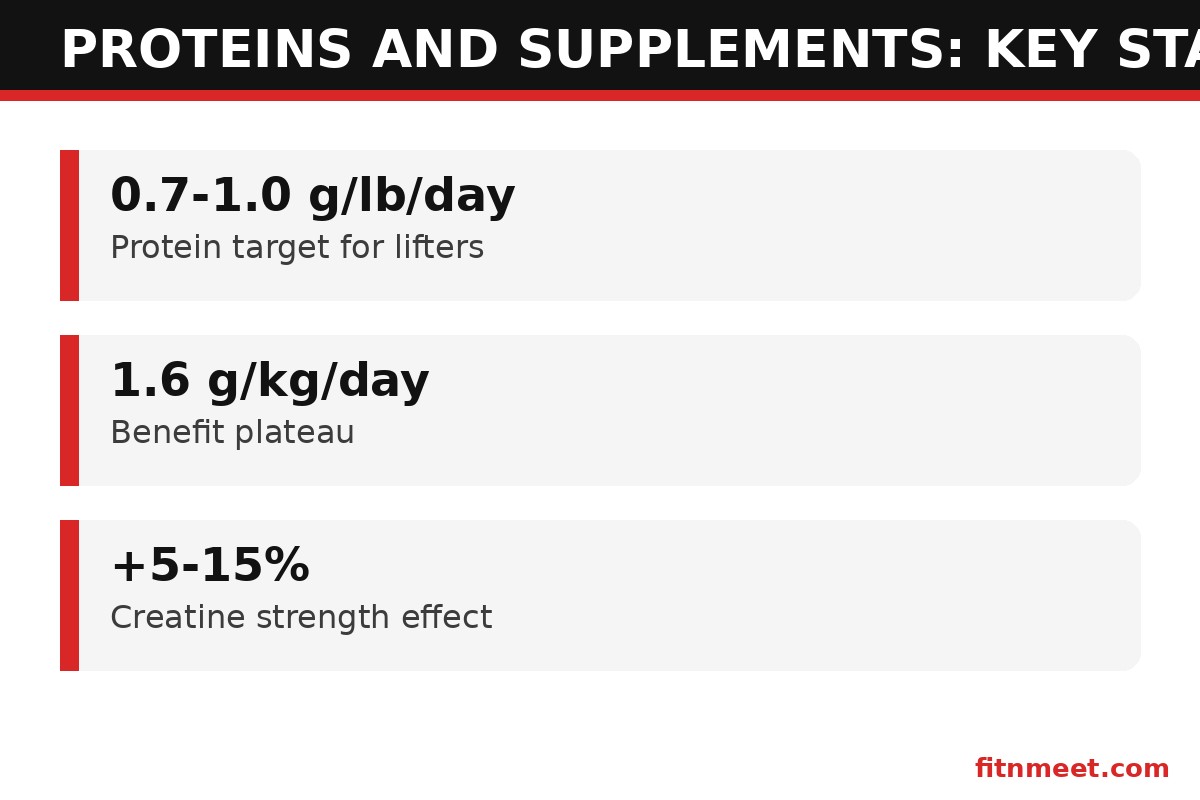
Beginners need adequate protein; they do not need supplements (plural). That distinction is the entire game. Your muscles are built from amino acids — the building blocks of protein — and training increases your daily requirement from the sedentary 0.36 g/lb to roughly 0.7-1.0 g/lb. Whether those grams come from chicken, eggs, Greek yogurt, or a shake is nearly irrelevant to your results. Supplements enter the picture only as convenient delivery systems for nutrients you would otherwise miss. If your diet already hits its protein target, the marginal benefit of adding more proteins and supplements to your routine is close to zero.
6 Myths vs Facts About Proteins and Supplements
Myth #1: Protein powder is basically steroids
✗ Myth: “Protein shakes are unnatural chemicals — basically legal steroids.”
✓ Fact: Whey protein is dried milk protein — the liquid left over from cheese-making, filtered and dried. It contains no hormones, no steroids, and nothing your body does not already get from milk, eggs, or meat. The protein nutrient overview on Wikipedia covers the biochemistry: protein is simply chains of amino acids your body breaks down and rebuilds.
Myth-debunk stat: A standard whey scoop (25 g protein) is nutritionally equivalent to about 4 eggs or 100 g of chicken breast — it is food in powdered form, not a drug. For whole-food options, see our list of high protein foods for muscle growth.
Myth #2: More protein always means more muscle
✗ Myth: “If 150 g is good, 300 g must be twice as good.”
✓ Fact: Muscle protein synthesis maxes out. A landmark 2018 meta-analysis (Morton et al., British Journal of Sports Medicine, 49 studies, 1,863 subjects) found protein intakes beyond ~1.6 g/kg/day (0.73 g/lb) produced no additional gains in muscle size or strength. Eating 2.5 g/lb does not build more muscle — it just makes expensive urine.
Myth-debunk stat: The plateau sits at ~1.6 g/kg/day; intakes above ~2.2 g/kg/day show zero additional benefit in controlled trials.
Myth #3: You cannot build muscle without supplements
✗ Myth: “The guys at the gym all take 6 supplements — I need a stack to see results.”
✓ Fact: Every gram of muscle ever built before 1950 was built without a single commercial supplement. Of the entire proteins and supplements market, only two products have strong, replicated evidence for muscle building: protein powder (a food convenience) and creatine monohydrate. Pre-workouts, BCAAs, test boosters, and fat burners range from marginally useful to useless for beginners.
Myth-debunk stat: BCAAs alone (leucine, isoleucine, valine) stimulate muscle protein synthesis ~22% less effectively than complete protein — you are paying more for an inferior product.
Myth #4: High protein destroys your kidneys
✗ Myth: “All that protein will wreck your kidneys.”
✓ Fact: In healthy people, high protein intakes (up to 2-3 g/kg/day in trials lasting a year or more) show no adverse effects on kidney function. This myth comes from clinical advice given to people who already have kidney disease — where protein is indeed restricted. Healthy kidneys handle high protein fine; the two populations were wrongly conflated.
Myth-debunk stat: A 1-year randomized trial of 2.5+ g/kg/day protein found zero negative kidney markers in healthy resistance-trained men.
Myth #5: You must drink protein within 30 minutes of training
✗ Myth: “Miss the 30-minute anabolic window and your workout was wasted.”
✓ Fact: Total daily protein intake explains roughly 95% of the nutrition effect; timing explains the rest. A 2018 review (Schoenfeld & Aragon, Journal of the International Society of Sports Nutrition) concluded the “window” is actually several hours wide — and mostly irrelevant if you ate protein 2-3 hours before training. Eat protein across 3-5 meals; stop setting a stopwatch.
Myth-debunk stat: Spreading protein across 4 meals stimulates ~25% more daily muscle protein synthesis than skewing it toward dinner — distribution beats timing.
Myth #6: Plant proteins cannot build muscle
✗ Myth: “Only animal protein builds muscle — plant protein is a waste.”
✓ Fact: Plant proteins are slightly lower in leucine and digestibility, but trials directly comparing pea or soy protein to whey — with total protein matched — find equivalent muscle and strength gains. The fix is simple: eat ~10-20% more total protein or combine sources (rice + pea covers the amino acid gaps).
Myth-debunk stat: In a 12-week trial, pea protein and whey produced statistically identical gains in muscle thickness when daily totals were matched.
What Are Proteins and Supplements, Really?
Protein is one of three macronutrients (alongside carbs and fat), made of amino acids — nine of which are “essential,” meaning your body cannot make them and you must eat them. When you lift weights, you create micro-damage in muscle fibers; dietary protein supplies the amino acids that repair and reinforce those fibers, which is the literal mechanism of muscle growth. Without enough protein, training stimulus goes partially to waste — which is why understanding proteins and supplements as separate categories matters so much — the signal is sent but the building materials never arrive.
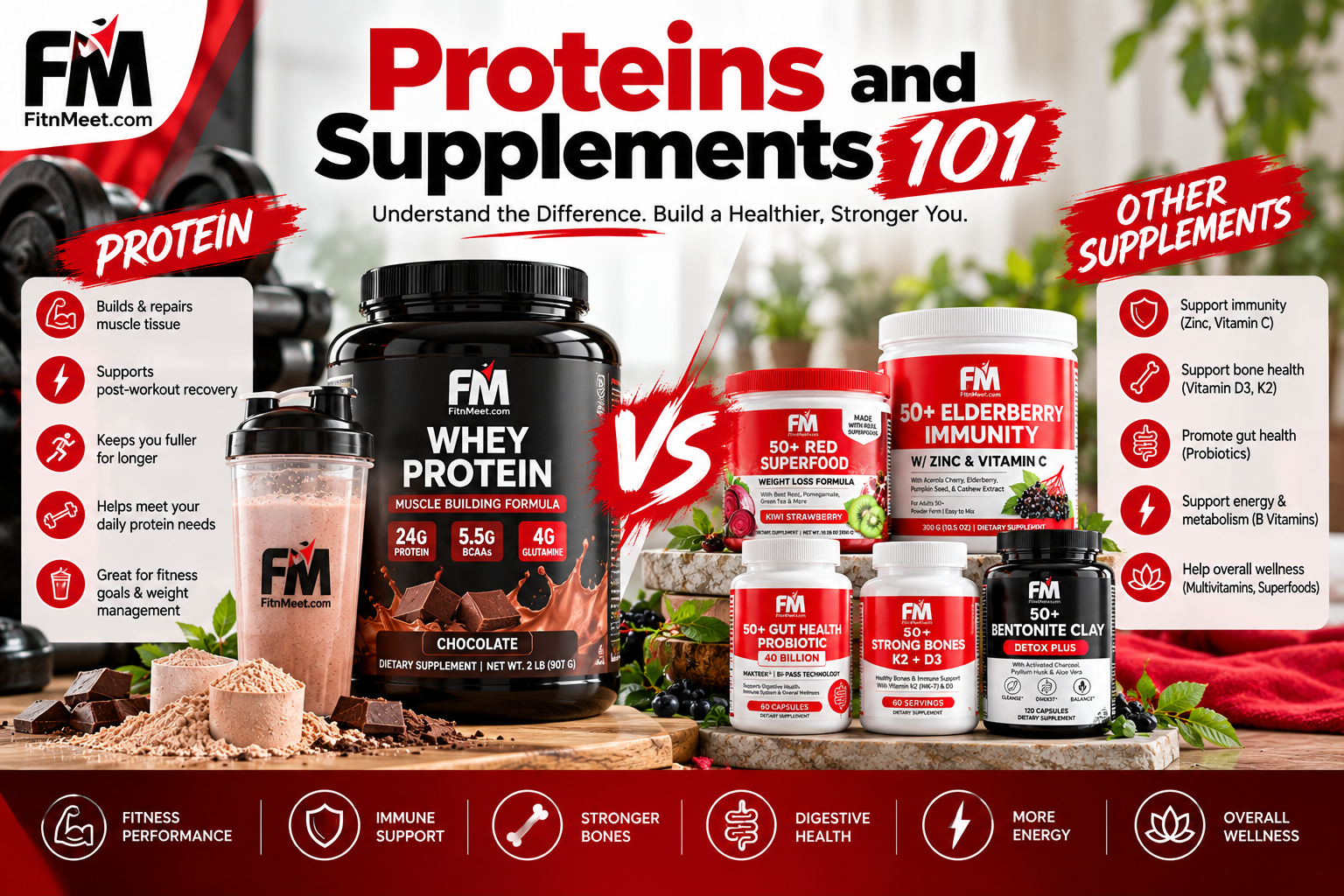
Supplements are concentrated nutrients sold in pills, powders, or liquids. The honest framework for the proteins and supplements category: supplements are gap-fillers, not game-changers. Protein powder fills the gap between what you eat and your 0.7-1.0 g/lb target. Creatine monohydrate (3-5 g/day) fills a gap your body cannot easily fill from food — you would need to eat ~1 kg of raw beef daily to match a 5 g creatine dose — and it is the most-studied sports supplement in existence, with hundreds of trials supporting strength and power gains of ~5-15%. Learn more about creatine monohydrate benefits and dosage.
Everything else sits on a steep evidence cliff. Multivitamins are reasonable insurance if your diet is poor. Vitamin D is worth testing (deficiency is common and impairs muscle function). Fish oil, magnesium, and zinc help only if you are deficient. Pre-workouts are mostly caffeine with marketing. Fat burners range from ineffective to risky. The beginner who masters protein intake and creatine has captured ~90% of what the entire proteins and supplements industry can legitimately offer.
Benefits of Getting Proteins and Supplements Right
Here is what getting proteins and supplements right actually delivers, in order of impact:
- Faster muscle growth: Hitting 1.6 g/kg/day versus the RDA-level 0.8 g/kg/day produces measurably greater lean-mass gains in resistance-training trials (Morton et al., 2018).
- Better recovery: Adequate protein reduces markers of muscle damage and perceived soreness, letting you train each muscle group 2-3× weekly — the frequency beginners respond to best.
- Strength gains: Creatine monohydrate adds ~5-15% to strength and power output across hundreds of trials — the largest reliable effect of any legal supplement.
- Body composition: Higher protein intake preserves lean mass during fat loss and increases satiety, making diets easier to sustain (protein is the most satiating macronutrient).
- Bone and tendon health: Protein supports collagen synthesis and bone mineral density — relevant for lifters loading their skeletons progressively.
- Money saved: The average beginner wastes $50-100/month on useless supplements. Knowing which proteins and supplements actually work redirects that money to food — which works better.
How to Use Proteins and Supplements: Do This, Not That
Apply this do-this-not-that framework to proteins and supplements and you will avoid 90% of beginner mistakes:
- Do this: Calculate your target (bodyweight in lb × 0.8) and track protein for one week to see your baseline. Not that: Buying $200 of supplements before knowing whether you even have a protein gap.
- Do this: Build each meal around a palm-to-two-palms portion of protein (meat, fish, eggs, dairy, legumes, tofu). Not that: Eating cereal all day and “fixing it” with three shakes.
- Do this: Use one protein shake per day as a convenient meal or snack to close the gap. Not that: Replacing whole-food meals with shakes — you lose fiber, micronutrients, and satiety.
- Do this: Take 3-5 g creatine monohydrate daily, any time, with any liquid — timing does not matter, saturation over weeks does. Not that: “Loading” 20 g/day or cycling off; neither is necessary.
- Do this: Choose third-party tested products (look for independent certification marks) — protein powders are among the most adulterated supplements. Not that: Trusting proprietary blends that hide actual ingredient doses.
- Do this: Reassess every 8-12 weeks: is the supplement still filling a real gap? Not that: Accumulating a graveyard of half-finished tubs bought on impulse.
The NIH Office of Dietary Supplements FAQ is a solid neutral starting point for evaluating any supplement claim you encounter.
Protein Dosage: How Much Do You Actually Need?
| Your situation | Daily protein target | Example (180 lb person) |
|---|---|---|
| Sedentary adult (RDA) | 0.36 g/lb (0.8 g/kg) | 65 g |
| Recreational lifter | 0.7-0.8 g/lb (1.6-1.8 g/kg) | 126-144 g |
| Serious muscle building | 0.8-1.0 g/lb (1.8-2.2 g/kg) | 144-180 g |
| Cutting (fat loss) | 1.0-1.2 g/lb (2.2-2.6 g/kg) | 180-216 g |
| Plant-based lifter | Add 10-20% to the above | 160-200 g |
Spread intake across 3-5 meals of 25-50 g each — muscle protein synthesis responds best to per-meal doses containing ~2.5-3 g of leucine (roughly 25-40 g of quality protein). One shake post-workout is fine, but it is the daily total and the per-meal distribution that drive results, not the shaker bottle timing.
For quality protein powder options, see whey protein isolate in our protein collection — and cover micronutrient gaps with the vitamins collection. To compare products, check our best protein powder guide 2026. Beginners may prefer the best whey protein vanilla for beginners as a tasty starting option.
Side Effects and Safety
Protein powder side effects are mild and usually traceable to lactose: cheap whey concentrate contains meaningful lactose, which causes bloating and gas in lactose-sensitive people — switching to whey isolate (lactose mostly removed) fixes it for most. Excessive protein in one sitting can cause fullness and mild GI discomfort, which is a portioning issue, not a toxicity issue — another reminder that most proteins and supplements scares are overblown. For the full story, read whey protein concentrate myths vs facts.
Creatine monohydrate’s safety record spans 30+ years and hundreds of trials: no adverse effects on kidneys or liver in healthy people at 3-5 g/day. The “creatine causes cramps/dehydration” myth was debunked by controlled trials showing no difference — or slightly fewer cramps — versus placebo. The one real caution: buy creatine monohydrate specifically (not exotic buffered or ethyl-ester forms with no evidence advantage), and anyone with pre-existing kidney disease should consult a doctor before any high-protein or creatine regimen.
The broader proteins and supplements safety rule: more ingredients means more risk. Single-ingredient products (whey, creatine monohydrate) have decades of safety data; multi-ingredient “proprietary blends” with stimulants, exotic herbs, and undisclosed doses are where adverse events cluster. When in doubt, simpler is safer.
Frequently Asked Questions
What proteins and supplements does a beginner actually need?
Just two things: enough total protein (0.7-1.0 g per pound of bodyweight daily, from food first) and optionally 3-5 g/day of creatine monohydrate. Every other product in the proteins and supplements aisle is optional for beginners — master these two before spending on anything else.
Is protein powder necessary to build muscle?
No — total daily protein is what matters, not the source. Protein powder is simply a convenient, cost-effective way to hit your target when whole food falls short. If you already eat 150+ grams of protein from food, a shake adds nothing.
How much protein should a 180-pound beginner eat?
About 130-180 grams per day (0.7-1.0 g/lb). Spread it across 3-5 meals of 25-50 g each. Research shows benefits plateau around 1.6 g/kg/day (0.73 g/lb), so there is no reason to exceed ~1.0 g/lb unless you are in a fat-loss phase.
Is creatine safe for beginners?
Yes. Creatine monohydrate is the most-studied sports supplement in existence, with hundreds of trials and 30+ years of use showing no adverse effects on kidneys or liver in healthy people at 3-5 g/day. It reliably adds 5-15% to strength and power output.
Can you build muscle with plant protein only?
Yes. Trials matching total daily protein find equivalent muscle and strength gains from pea, soy, or rice-pea blends versus whey. Aim ~10-20% higher total intake or combine sources (e.g., rice + pea) to cover the slightly lower leucine and digestibility of plant proteins.
When should I take protein and creatine?
Total daily intake matters far more than timing. Take creatine any time of day (saturation over weeks is what counts), and distribute protein across 3-5 meals. The 30-minute post-workout ‘anabolic window’ is largely a myth — the real window is several hours wide.
Conclusion
The proteins and supplements world runs on confusion because confusion sells tubs. The reality is refreshingly simple: hit 0.7-1.0 g of protein per pound daily from mostly whole food, consider 3-5 g of creatine monohydrate, and ignore everything else until those two are dialed in for months. You will build more muscle and save hundreds of dollars a year. Ready to cover the essentials? Browse FitnMeet’s shop for quality protein and explore the blog for more no-hype nutrition guides.
This article is for informational purposes only and is not medical advice. Consult a healthcare professional before starting any supplement.