
Whey protein concentrate (WPC) is the least-processed, most affordable form of whey protein, typically containing 70–80% protein by weight along with small amounts of lactose, fat and bioactive peptides. For most lifters, it delivers the same muscle-building results as pricier isolates at a lower cost per gram of protein.
Quick Answer: Should You Buy Whey Protein Concentrate?
Yes, if you tolerate dairy and want the best protein-per-dollar. It gives you 70–80% protein with a complete amino acid profile, proven muscle-building effects in dozens of trials, and a price 20–40% below isolate. Choose isolate instead only if you are lactose intolerant or cutting calories aggressively.
Common Myths vs Facts About Whey Protein Concentrate
Myth 1: “Whey protein concentrate is low quality compared to isolate.”
✗ Myth: Because this protein is cheaper and less processed, it must be an inferior, “dirty” protein.
✓ Fact: The “impurities” in WPC are lactose, milk fat and bioactive peptides like lactoferrin and immunoglobulins — compounds with their own health research. The protein fraction itself has the same complete amino acid profile and high leucine content (~10–11%) as isolate. Multiple head-to-head trials show no meaningful difference in muscle gain between the two when total protein is matched.
Myth 2: “Whey protein concentrate will make you fat.”
✗ Myth: The extra carbs and fat in whey protein concentrate cause fat gain.
✓ Fact: A 30 g scoop of whey protein concentrate has roughly 120–140 calories versus ~110 for isolate — a 10–30 calorie difference, trivial in any diet. Fat gain comes from sustained calorie surplus, not from the 3–5 g of milk fat in your shake. In fact, trials show whey protein concentrate supports fat loss during dieting by preserving lean mass and improving satiety.
Myth 3: “Whey protein concentrate causes bloating in everyone.”
✗ Myth: The lactose in WPC upsets every stomach.
✓ Fact: WPC contains about 3–5 g lactose per scoop — less than half a glass of milk. Most people, including many with mild lactose sensitivity, tolerate it fine. Only those with true lactose intolerance or milk allergy consistently have issues, and they should choose isolate or a non-dairy protein instead.
Myth 4: “You need isolate post-workout because whey protein concentrate digests too slowly.”
✗ Myth: Only the fastest-absorbing protein works after training.
✓ Fact: Both WPC and isolate are fast-digesting proteins, raising blood amino acids within 60–90 minutes. The digestion-speed difference between them is minutes, not hours. Total daily protein intake predicts muscle gain far better than protein timing or whey subtype — a finding replicated across dozens of studies.
Myth 5: “Whey protein concentrate damages your kidneys.”
✗ Myth: High-protein supplements harm healthy kidneys.
✓ Fact: In people with healthy kidneys, high protein intakes (up to 2.2 g/kg/day and beyond) show no kidney damage in controlled trials. This myth confuses therapeutic protein restriction for existing kidney disease with harm in healthy people. WPC is simply food — concentrated milk protein — not a drug.
What Is Whey Protein Concentrate?
Whey is the liquid left over from cheese-making. To make WPC, that liquid is filtered to remove water, lactose and minerals, then spray-dried into powder. The result: 70–80% protein (WPC-80 is the common sports-nutrition grade), with the remainder being lactose, fat and moisture. Less filtration than isolate means lower cost and more of whey’s natural bioactive fractions — which is a feature, not a flaw.
Nutritionally, whey protein concentrate is a complete protein with all nine essential amino acids and a biological value around 104 — among the highest of any protein source. Its leucine content (~10–11% of protein) is the key driver of muscle protein synthesis: leucine acts as the signal that tells muscle cells to start building. The whey protein entry on Wikipedia summarizes the production grades and composition for the curious.
Reading a WPC Label Like a Skeptic
Not all tubs labeled “whey protein concentrate” are equal. Check the supplement facts: protein should be 70-80% of the scoop weight (a 30 g scoop delivering 24 g protein is honest WPC-80; delivering 18 g means fillers). Ingredients should list whey protein concentrate first. Watch for “amino spiking” – added glycine, taurine or creatine that inflate nitrogen-based protein tests without adding complete protein. Third-party certifications (NSF Certified for Sport, Informed Choice) are the gold standard for label accuracy and contaminant screening.
Benefits of Whey Protein Concentrate
- Proven muscle growth: meta-analyses of whey supplementation trials show ~1–2 kg additional lean mass versus control over 8–12 week training programs when protein intake is otherwise equal.
- Best protein per dollar: WPC typically costs 20–40% less per gram of protein than isolate — the same gains for meaningfully less money.
- Complete amino profile: all essential amino acids in ratios close to human muscle, with glutamine and BCAAs abundant for recovery.
- Satiety and fat loss: whey protein concentrate increases fullness hormones (GLP-1, PYY) more than casein or soy in acute trials, aiding diet adherence.
- Immune-supporting fractions: lactoferrin and immunoglobulins retained in WPC have documented antimicrobial and immune-modulating properties.
- Convenience: 25 g of protein in 30 seconds, anywhere — the compliance advantage of a quick shake over “perfect” whole-food plans you skip.
- Versatility: blends into shakes, oats, yogurt, pancakes and baking without the chalkiness of many plant proteins.
How to Use Whey Protein Concentrate: Do This, Not That
- ✓ Do use WPC to fill the gap between your food protein and your target (1.6–2.2 g/kg/day for muscle gain).
- ✗ Don’t replace whole meals with shakes habitually — food provides micronutrients and fiber powder cannot.
- ✓ Do mix with water or milk post-workout, or blend into a morning smoothie for an easy 30–40 g protein start.
- ✗ Don’t assume more scoops equal more muscle — beyond ~2.2 g/kg/day, extra powder mostly becomes expensive calories.
- ✓ Do store the tub sealed in a cool, dry place; moisture clumps the powder and heat degrades it over months.
- ✗ Don’t buy on price alone — check that the label lists WPC as the first ingredient, not a “protein blend” padded with cheap aminos.
- ✓ Do try a small tub first if you are new to dairy proteins, to confirm your stomach agrees before committing to 5 lbs.
Dosage Guide
Dosing WPC is simple because it is food, not pharmacology. Calculate your target: 1.6–2.2 g of total protein per kg of bodyweight daily for muscle gain (1.2–1.6 g/kg for maintenance). Subtract what you eat, and fill the remainder with shakes — typically 1–2 scoops (25–50 g protein) per day for most lifters. Pair your whey protein concentrate intake with progressive training — the FitnMeet strength training category covers programming for growth.
| Goal | Bodyweight | Daily protein target | Typical WPC scoops |
|---|---|---|---|
| Muscle gain | 70 kg | 112–154 g | 1–2 scoops |
| Muscle gain | 90 kg | 144–198 g | 2 scoops |
| Fat loss (high protein) | 80 kg | 160–200 g | 2 scoops |
| Maintenance | 70 kg | 84–112 g | 0–1 scoop |
Timing is flexible: post-workout, morning, or between meals all work. Splitting intake across 3–5 protein feedings of 25–40 g each slightly optimizes muscle protein synthesis versus one giant dose — so spread your intake through the day rather than triple-scooping at night.
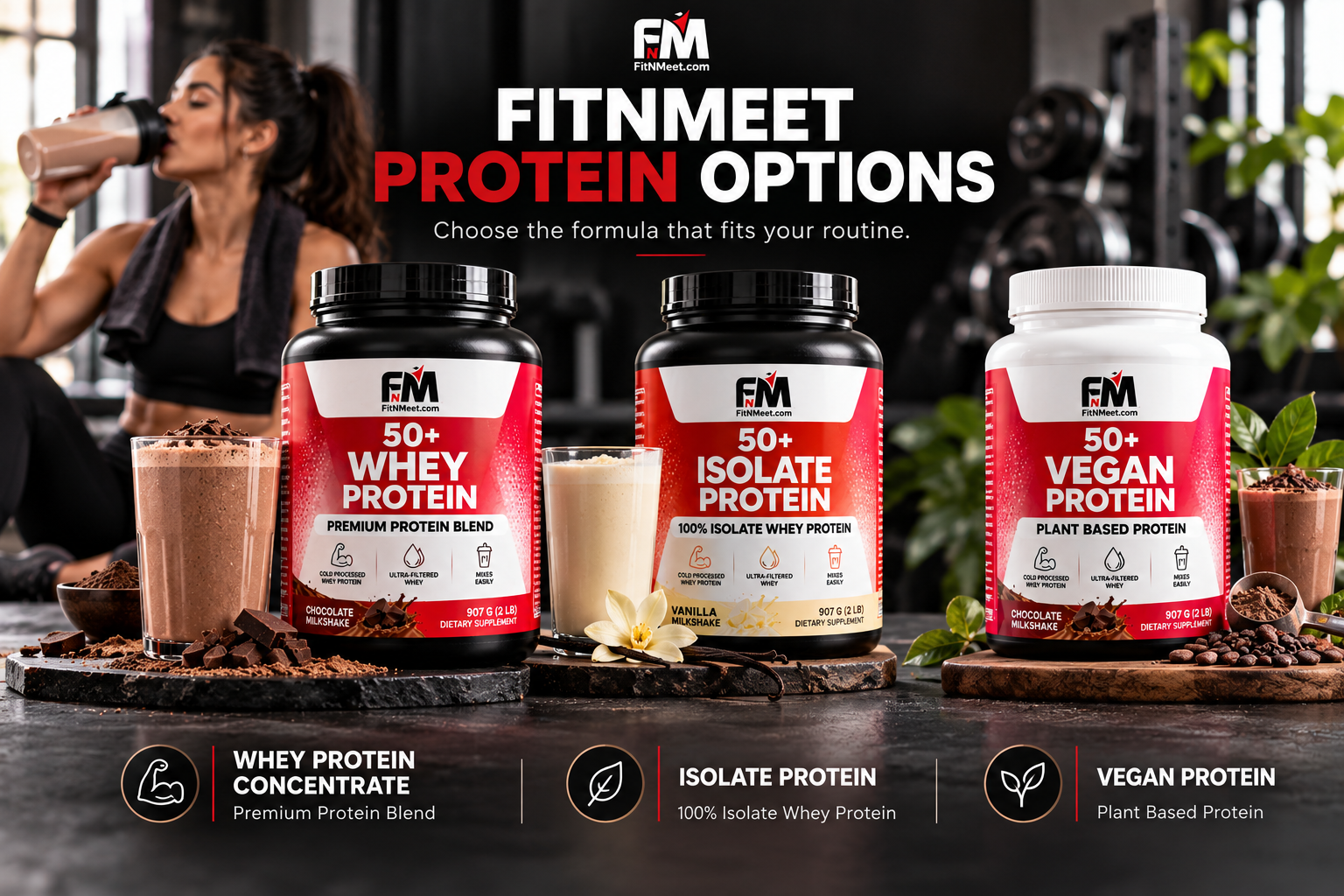
Stocking your protein shelf? Compare options in the FitnMeet protein collection, including whey protein isolate for lactose-sensitive lifters, and fuel training with the sports nutrition range. Find all these options in the FitnMeet shop.
Who Should Choose Isolate Instead?
WPC is the right default, but isolate wins in three cases. True lactose intolerance: the near-zero lactose in isolate avoids the digestive distress WPC can cause. Aggressive calorie deficits: isolate saves 10-30 calories per scoop, which matters when every calorie is counted. Milk protein texture sensitivity: some people simply digest isolate’s cleaner profile better during high-volume phases. For everyone else, the price gap buys no additional muscle.
Cooking and Baking With WPC
Heat denatures whey protein, which changes texture but not the amino acid content – your muscles cannot tell the difference between a shake and a protein pancake. For baking, replace up to one-third of flour with WPC; expect denser results and add extra liquid. Avoid boiling shakes (curdling), and add powder to oats after cooking rather than during. These tricks turn WPC into a genuine meal-prep tool rather than just a shaker-bottle ritual.
Side Effects and Safety
WPC is one of the most studied supplements in existence, with an excellent safety record in healthy people. The realistic side effects: mild bloating or gas in the lactose-sensitive (try a smaller serving or switch to isolate), and acne flare-ups in a minority of users — possibly linked to dairy’s effect on IGF-1. People with milk allergy must avoid it entirely; this is distinct from lactose intolerance.
Quality note: independent testing has occasionally found heavy-metal traces in protein powders generally. Choose products from reputable manufacturers, and consult the FDA supplement resources and NIH guidance on sports supplements for label-reading basics.
This article is for informational purposes only and is not medical advice. Consult a healthcare professional before starting any supplement, especially if you have kidney disease, a milk allergy, or take medication.
WPC and Women: A Note on Marketing
Protein marketing often implies women need special “lean” formulas. They do not. The physiology of muscle protein synthesis works identically, and WPC suits women lifters exactly as it suits men – the only adjustment is total dose, scaled to bodyweight. The 1.6-2.2 g/kg guideline applies regardless of sex; a 60 kg woman building muscle targets roughly 96-132 g daily, with WPC filling whatever food does not cover. Do not pay extra for pink packaging.
Travel and Work: Staying Consistent
The best protein is the one you actually take. Single-serve sachets solve travel; a small container with a pre-measured scoop lives in a gym bag or desk drawer. Mixed shakes keep 24 hours refrigerated, so a morning batch covers the workday. Consistency over months beats any timing trick – the lifters who hit their protein target 300 days a year outgrow the ones chasing perfect peri-workout windows for 100 days.
Frequently Asked Questions
What is whey protein concentrate?
Whey protein concentrate (WPC) is filtered, dried whey from cheese-making, containing 70-80% protein plus small amounts of lactose, fat and bioactive peptides. It is the least-processed and most affordable form of whey protein.
Is whey protein concentrate as good as isolate?
For muscle building, yes – head-to-head trials show no meaningful difference when total protein intake is matched. Isolate wins only for lactose-intolerant users or those minimizing every calorie, at a 20-40% price premium.
How much whey protein concentrate should I take daily?
Most lifters need 1-2 scoops (25-50 g protein) per day to reach 1.6-2.2 g/kg total protein. Calculate your food protein first, then fill the gap – more scoops beyond your target just add calories.
Does whey protein concentrate cause bloating?
It can in lactose-sensitive people, since WPC contains 3-5 g lactose per scoop. Most people tolerate it fine. If you bloat consistently, try a smaller serving, take it with food, or switch to isolate.
When should I take whey protein concentrate?
Timing is flexible – post-workout, morning, or between meals all work. Spreading protein across 3-5 daily feedings of 25-40 g slightly optimizes muscle protein synthesis versus one large dose.
Can whey protein concentrate help with weight loss?
Yes. Whey protein concentrate preserves lean mass during calorie deficits and increases satiety hormones more than many other proteins, making diets easier to sustain. It is a staple in evidence-based fat-loss plans.
Conclusion
The myths do not survive contact with the evidence: whey protein concentrate is a complete, fast-digesting, well-tolerated protein that builds muscle as effectively as isolate for most people — at a meaningfully lower price. Buy a transparently labeled WPC-80, dose to your daily protein target, and spend the savings on food or your gym membership. Compare quality options in the FitnMeet protein collection.